Metabolism
on-line - the virtual tutorial room
copyright © 2008 - 2014 David A Bender
Urea synthesis in the liver, and potentially fatal hyperammonaemia in a child
Studies with isolated hepatocytes
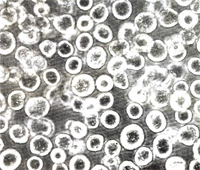 Krebs
and Henseleit used very thin slices of liver, approximately one cell thick,
for their studies. The results here are from more recent experiments using isolated
liver parenchymal cells (hepatocytes).
Krebs
and Henseleit used very thin slices of liver, approximately one cell thick,
for their studies. The results here are from more recent experiments using isolated
liver parenchymal cells (hepatocytes).
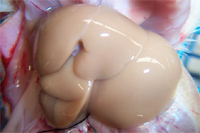 Isolated hepatocytes provide an extremely convenient
system for metabolic investigations. The isolated cells are prepared by perfusion
of the liver in situ with collagenase; as the collagen in connective
tissue is hydrolysed, so the cells can be separated by gentle pressure, and
suspended in buffer for incubation. A relatively large number of experiments
can be performed using the cells from the liver of each rat or mouse.
Isolated hepatocytes provide an extremely convenient
system for metabolic investigations. The isolated cells are prepared by perfusion
of the liver in situ with collagenase; as the collagen in connective
tissue is hydrolysed, so the cells can be separated by gentle pressure, and
suspended in buffer for incubation. A relatively large number of experiments
can be performed using the cells from the liver of each rat or mouse.
 The main urinary
nitrogen metabolite in mammals is urea.
The main urinary
nitrogen metabolite in mammals is urea.
What is the main factor that determines how much urea is synthesised and excreted?
The dietary intake of protein is the main factor that determines how much urea is synthesised and secreted, since protein is the main source of nitrogenous compounds in the diet. Remember that for an adult in nitrogen balance the excretion of nitrogenous compounds (mainly urea in the urine) is equal to the dietary intake of nitrogenous compounds. See the exercise on Nitrogen balance and protein requirements for more on this topic.
When isolated hepatocytes with increasing concentrations of ammonium, there is a steady increase in the formation of urea at low concentrations of ammonium, levelling off as the pathway for urea formation becomes saturated. If such studies are performed with isotopically labelled ammonium (15N, a stable isotope) only one of the two N atoms in urea is labelled.
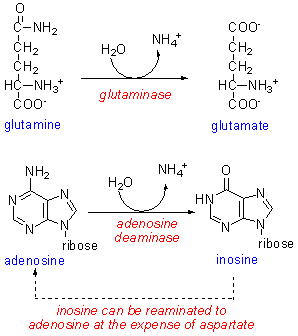 The
sources of ammonium ions in the liver
The
sources of ammonium ions in the liver
There are two ways in which ammonium is formed in the liver: from glutamine by the action of glutaminase, and from adenosine, by the action of adenosine deaminase. Each provides about half the ammonium that is incorporated into urea directly.
Glutamine is formed from ammonium in peripheral tissues, as a way of transporting ammonium arising from amino acid and amine metabolism to the liver.
What is the pathway of glutamine formation in peripheral tissues?
Glutamine is synthesised by incorporation of two mol of ammonium into alpha-ketoglutarate, forming first glutamate, then glutamine.

In the liver, glutamine is formed from glutamate and ammonium in the perivenous cells to prevent the escape of ammonium into the peripheral circulation.
See the exercise on Hyperammonaemic coma due to liver failure for the importance of glutamate dehydrogenase in ammonia metabolism, especially in the brain.
The reaction of adenosine deaminase, shown in the lower half of the diagram on the right, and the reamination of inosine to adenosine at the expense of aspartate, occur in the liver, and provide a pathway for the formation of ammonium from aspartate.
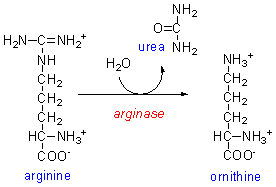 Experiment
1: the effect of arginine on urea synthesis
Experiment
1: the effect of arginine on urea synthesis
One possible source of urea is the reaction of arginase, which catalyses hydrolysis of the amino acid arginine to yield urea and ornithine, as shown on the right.
Isolated hepatocytes were incubated with varying concentrations of ammonium chloride and 0, 2.5, 5 or 10 mmol /L arginine. The reaction was stopped after 30 min by addition of trichloroacetic acid, and denatured protein was removed by centrifugation. The amount of urea in the supernatant form each incubation was measured by reaction with diacetyl monoxime, ferric ions and thiosemicarbazide to form a red colour that was measured at 540nm.
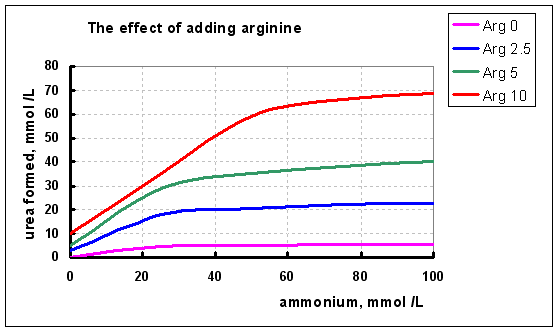 The results
are shown in the table below and the graphs on the right.
The results
are shown in the table below and the graphs on the right.
Urea formed (mmol /L) in the presence of different concentrations of arginine, with no added ammonium or a saturating amount (100 mmol /L)
arginine added (mmol /L) |
||||
| ammonium added (mmol /L) | 0 |
2.5 |
5 |
10 |
0 |
0 |
2.5 |
5.0 |
9.9 |
100 |
5.6 |
23.0 |
40.8 |
73.0 |
What conclusions can you draw from these results?
When no ammonium is provided to the hepatocytes, there is stoichiometric formation of urea from arginine. 1 mol of urea is formed fro each mol of arginine added.
However, in the presence of a saturating amount of ammonium there is considerably more urea formed per mol of arginine than can be accounted for by the amount of arginine added.
This suggests that arginine either has a catalytic effect or acts in some other way to increase the rate of formation of urea from ammonium.
Experiment 2: The effect of ornithine on urea synthesis
Since the product of the reaction catalysed by arginase is ornithine, it will be interesting to see the effect of adding ornithine to the incubations. In this experiment, isolated hepatocytes were incubated with varying concentrations of ammonium chloride and 0, 2.5, 5 or 10 mmol /L ornithine, for 30 minutes. The reaction was stopped and the amount of urea formed was measured as described for experiment 1.
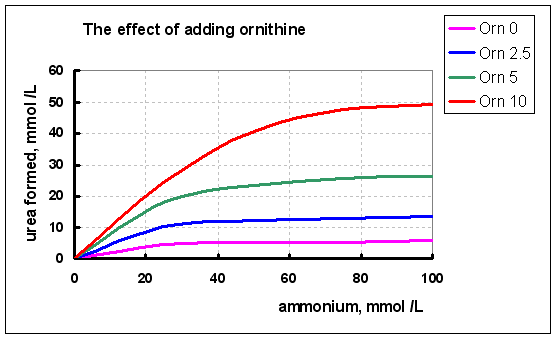 The results
are shown in the table below and the graphs on the right.
The results
are shown in the table below and the graphs on the right.
Urea formed (mmol /L) in the presence of different concentrations of ornithine, with no added ammonium or a saturating amount (100 mmol /L)
ornithine added (mmol /L) |
||||
| ammonium added (mmol /L) | 0 |
2.5 |
5 |
10 |
0 |
0 |
0 |
0 |
0 |
100 |
5.9 |
14.1 |
27.3 |
54.0 |
What conclusions can you draw from these results?
There is no formation of urea when no ammonium is provided. This is as you would expect from the chemistry of ornithine; there is no way in which it can be a source of urea directly.
However, in the presence of ammonium, there is considerably more urea formed when ornithine is added than when no ornithine is added. It therefore seems possible that both arginine and ornithine are intermediates in the pathway of urea synthesis, and increasing the amount of either will increase the rate of urea formation.
Experiment 3:The metabolism of ornithine
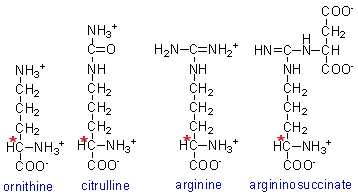 Isolated hepatocytes
were incubated with 100 mmol /L ammonium chloride and 10 mmol /L [14C-2]ornithine
at a specific radioactivity of 0.1 µCi /mmol for 30 minutes. The reaction
was stopped by the addition of trichloroacetic acid, followed by centrifugation
to precipitate denatured protein. The supernatant was neutralised and metabolites
were measured by liquid chromatography and scintillation counting to determine
radioactivity.
Isolated hepatocytes
were incubated with 100 mmol /L ammonium chloride and 10 mmol /L [14C-2]ornithine
at a specific radioactivity of 0.1 µCi /mmol for 30 minutes. The reaction
was stopped by the addition of trichloroacetic acid, followed by centrifugation
to precipitate denatured protein. The supernatant was neutralised and metabolites
were measured by liquid chromatography and scintillation counting to determine
radioactivity.
In addition to ornithine, three compounds were found to be labelled: citrulline, arginine and one that was eventually identified as argininosuccinate. The asterisk shows the labelled carbon atom, as determined by mass fragmentation studies.
What conclusions can you draw from these results?
It now seems likely that arginine, which we know is hydrolysed to yield urea and ornithine, is synthesised from ornithine, since label from [14C]ornithine appears in arginine. Citrulline and argininosuccinate seem to be intermediates in the pathway.
Experiment 4: The effect of citrulline on urea synthesis
In this experiment, isolated hepatocytes were incubated with varying concentrations of ammonium chloride and 0, 2.5, 5 or 10 mmol /L citrulline, for 30 minutes. The reaction was stopped and the amount of urea formed was measured as described for experiment 1.
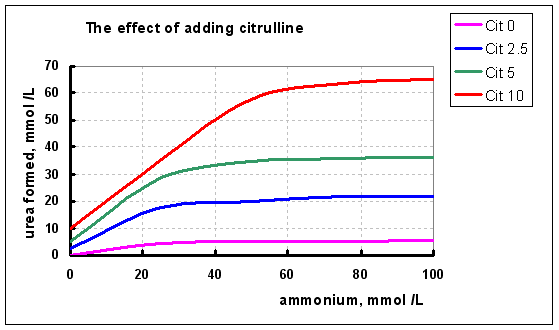 The results
are shown in the table below and the graphs on the right.
The results
are shown in the table below and the graphs on the right.
Urea formed (mmol /L) in the presence of different concentrations of citrulline, with no added ammonium or a saturating amount (100 mmol /L)
citrulline added (mmol /L) |
||||
| ammonium added (mmol /L) | 0 |
2.5 |
5 |
10 |
0 |
0 |
2.5 |
5.0 |
9.9 |
100 |
5.6 |
22.4 |
38.0 |
69.9 |
What conclusions can you draw from these results?
These results are similar to those seen when arginine was added to the incubation. With no added ammonium there is stoichiometric formation of urea from citrulline. 1 mol of urea is formed for each mol of citrulline added.
However, in the presence of a saturating amount of ammonium there is considerably more urea formed per mol of citrulline than can be accounted for by the amount of citrulline added.
This suggests that the nitrogen added when citrulline is formed from ornithine has come from ammonium.
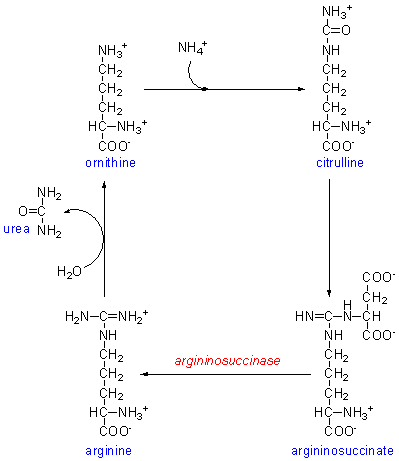 The
catalytic effect of adding arginine, ornithine or citrulline on urea synthesis
from ammonium suggests that there is a cyclic pathway, with ornithine, citrulline,
argininosuccinate and arginine as intermediates.
The
catalytic effect of adding arginine, ornithine or citrulline on urea synthesis
from ammonium suggests that there is a cyclic pathway, with ornithine, citrulline,
argininosuccinate and arginine as intermediates.
Experiment 5: The incorporation of ammonium
The reaction to form citrulline from ornithine involves incorporation of both nitrogen and carbon, as shown in the diagram on the right.
In this experiment, isolated hepatocytes were incubated with 100 mmol /L ammonium chloride, 10 mmol /L ornithine and [14C] sodium bicarbonate at a specific radioactivity of 0.1 µCi /mmol for 30 minutes. The reaction was stopped by the addition of trichloroacetic acid, followed by centrifugation to precipitate denatured protein. The supernatant was neutralised and metabolites were measured by liquid chromatography and scintillation counting to determine radioactivity.
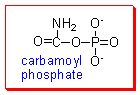 Radioactivity
was found in citrulline, argininosuccinate, arginine and urea, and a metabolite
that was identified as carbamoyl phosphate (shown on the left).
Radioactivity
was found in citrulline, argininosuccinate, arginine and urea, and a metabolite
that was identified as carbamoyl phosphate (shown on the left).
What conclusions can you draw from these results?
It seems likely that ammonium is incorporated into carbamoyl phosphate, and then into citrulline.
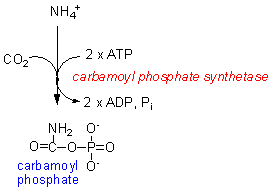 Carbamoyl
phosphate is synthesised from ammonium, carbon dioxide and ATP in the reaction
catalysed by carbamoyl phosphate synthetase, shown on the left.
Carbamoyl
phosphate is synthesised from ammonium, carbon dioxide and ATP in the reaction
catalysed by carbamoyl phosphate synthetase, shown on the left.
There are two isoenzymes of carbamoyl phosphate synthetase in liver cells:
carbamoyl phosphate synthetase 1 is a mitochondrial enzyme; it is induced by feeding a high-protein diet.
carbamoyl phosphate synthetase 2 is a cytosolic enzyme; it is inhibited by pyrimidine nucleotides. (Carbamoyl phosphate is the starting substrate for pyrimidine synthesis).
Which isoenzyme is likely to be important for the synthesis of urea?
Carbamoyl phosphate synthetase 1, the mitochondrial enzyme that is induced by feeding a high protein diet. (This isoenzyme uses ammonium as the source of nitrogen; the cytosolic enzyme that is involved in pyrimidine synthesis uses glutamine directly as its substrate.)
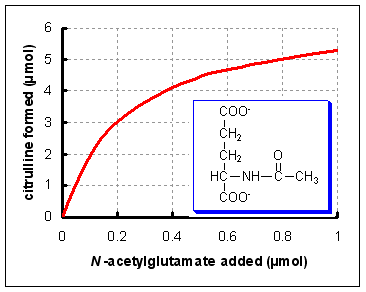 Hall
and coworkers (1958) reported that synthesis of citrulline from ornithine by
liver preparations required not only ATP, ammonium and bicarbonate, but also
a soluble factor that could be isolated from liver, and which they identified
as N-acetylglutamate (shown in the inset box in the graph on the right).
Hall
and coworkers (1958) reported that synthesis of citrulline from ornithine by
liver preparations required not only ATP, ammonium and bicarbonate, but also
a soluble factor that could be isolated from liver, and which they identified
as N-acetylglutamate (shown in the inset box in the graph on the right).
The graph on the right shows the effect of adding N-acetylglutamate on the formation of citrulline.
[From data reported by Hall, LM et al, Journal of Biological
Chemistry 230: 1013, 1958]
At the end of the incubations the same amount of N-acetylglutamate remained in the incubations as had been added - i.e. it was not consumed in the reaction. Subsequent studies with [14C]N-acetylglutamate showed that no other compounds became labelled during the incubation.
When carbamoyl phosphate was provided, instead of ammonium, bicarbonate and ATP, citrulline was formed without the need for any added N-acetylglutamate, and adding N-acetylglutamate had no effect on the amounts of citrulline formed.
What conclusions can you draw from these results?
The amount of citrulline formed is ~5-fold higher than the amounts of N-acetylglutamate added, and N-acetylglutamate is not consumed, not is it incorporated into any other compound. This means that it is not an intermediate in the reaction pathway.
N-Acetylglutamate is an obligatory activator of carbamoyl phosphate synthetase.
 It was
noted above that when [15N]ammonium is used, only one of the nitrogen atoms
in urea is labelled. This raises the question of the source of the second nitrogen
atom in urea.
It was
noted above that when [15N]ammonium is used, only one of the nitrogen atoms
in urea is labelled. This raises the question of the source of the second nitrogen
atom in urea.
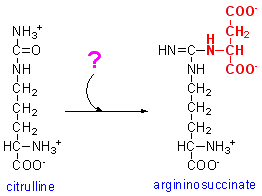
From the structures of citrulline and argininosuccinate, shown on the right, what is the likely second substrate for argininosuccinate synthetase?
The second nitrogen of urea comes from aspartate; the reactions of argininosuccinate synthetase and argininosuccinase are shown below:
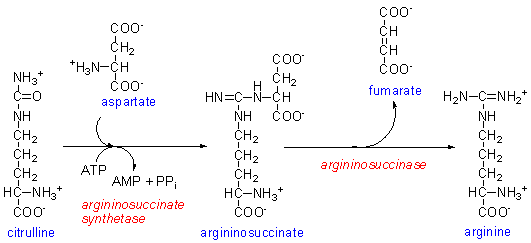
Experiments using [14C]aspartate showed that as well as fumarate, malate and oxaloacetate became labelled.
Experiments using [14C] fumarate showed that as well as malate and oxaloacetate, aspartate also became labelled.